
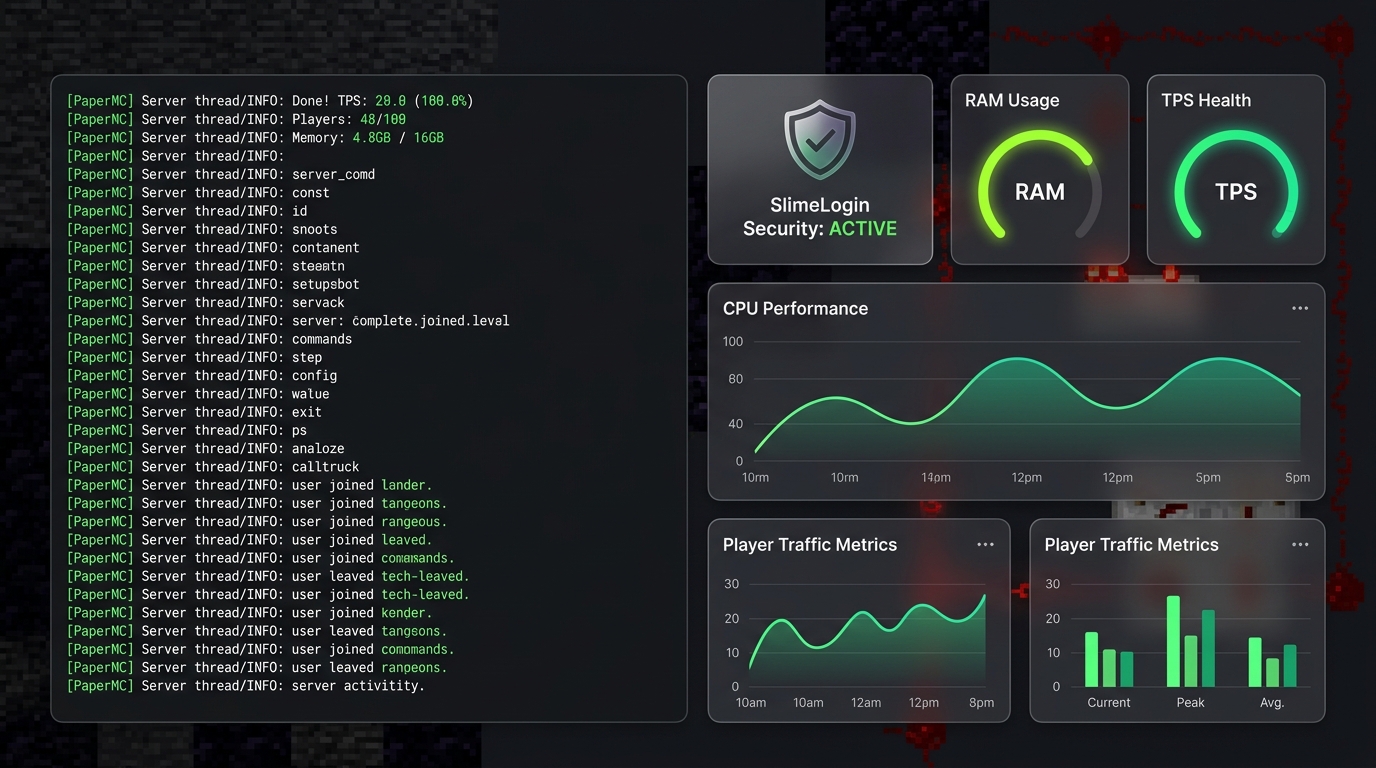
Running a successful Minecraft server in 2026 requires much more than simply allocating RAM and clicking start. Modern Minecraft versions (from 1.20 to 1.21+) introduce sophisticated world generation, expanded entity behaviors, and intense CPU demands. Without systematic architecture, even premium dedicated hardware can suffer from severe tick drop, memory leaks, and vulnerability exploits.
In this comprehensive, production-tested guide, we break down the definitive blueprint for architecting, fine-tuning, and locking down a rock-solid Minecraft server capable of sustaining peak player counts at a flawless 20 TPS.
1. Choosing the Right Core Engine: Why Paper and Purpur Reign Supreme
Your choice of server software dictates your maximum performance ceiling:
-
Vanilla / Spigot: Outdated for modern public multiplayer. Spigot lacks the asynchronous processing pipelines necessary for smooth gameplay.
-
PaperMC: The industry benchmark. Paper patches game-breaking exploits, decouples chunk loading from the main tick loop, and exposes granular configuration options.
-
Purpur: An enterprise-grade fork of Paper offering extra performance toggles, customizable mob mechanics, and enhanced entity tracking controls.
# Recommended Java startup flags for Paper (Aikar's optimized G1GC flags)
java -Xms8G -Xmx8G -XX:+UseG1GC -XX:+ParallelRefProcEnabled -XX:MaxGCPauseMillis=200 \
  -XX:+UnlockExperimentalVMOptions -XX:+DisableExplicitGC -XX:+AlwaysPreTouch \
  -XX:G1NewSizePercent=30 -XX:G1MaxNewSizePercent=40 -XX:G1ReservePercent=20 \
  -XX:G1HeapWastePercent=5 -XX:G1MixedGCCountTarget=4 -XX:InitiatingHeapOccupancyPercent=15 \
  -XX:G1MixedGCLiveThresholdPercent=90 -XX:G1RSetUpdatingPauseTimePercent=5 \
  -XX:SurvivorRatio=32 -XX:+PerfDisableSharedMem -XX:MaxTenuringThreshold=1 \
  -jar paper.jar --nogui
2. Server Security: Eliminating Account Hijacking and Bot Raids
Player trust is the lifeblood of any gaming community. Offline-mode networks, cracked authentication setups, and even standard online servers face brute-force attacks and session spoofing.
Deploying Standalone, Dependency-Free Authentication
Traditional auth plugins often suffer from database locks or rely on heavy external libraries that introduce lag upon player join bursts. A modern, hardened security layer like Slime Login - Standalone Auth Plugin provides an airtight defense:
-
No external dependencies: Runs completely standalone without bloated prerequisites.
-
Built-in Session & Captcha verification: Thwarts automated bot swarms before they ever execute commands.
-
Instant Password & PIN Hashing: Implements industry-standard cryptographic hashing to keep player credentials safe even in the event of database leaks.
By preventing bot floods at the login gateway, your server avoids the massive tick stalls that typically accompany brute-force bot attacks.
3. Automated Maintenance: Preventing Memory Leaks and Heap Fragmentation
Java applications inherently experience garbage collection overhead over extended runtimes. Leaving a server running unattended for weeks causes memory fragmentation, uncollected entity references, and progressive TPS drops.
Instead of manual reboots, implement scheduled, graceful restarts using a dedicated controller like TimeRestart Plugin.
Recommended Restart Schedule
-
Daily Maintenance Window: Set automated restarts during off-peak hours (e.g., 4:00 AM UTC).
-
Dynamic Countdown Warnings: Give players 15-minute, 5-minute, and 60-second in-game boss bar or title alerts to wrap up fights and trades.
-
Graceful World Saving: Ensure chunk saving completes asynchronously before the process terminates, preventing rollbacks and corrupt region files.
4. Elevating the Player Experience: Survival Enhancements and Retention
Keeping players engaged after the initial hype requires rewarding gameplay loops that remove tedious friction while preserving survival balance.
Streamlining Resource Gathering
Chopping massive oak and jungle trees block by block is one of the most tedious early-game grinds. Integrating a lightweight mechanics plugin like OneHitTree transforms tree chopping:
-
Players break a single trunk block to fell the entire tree structure.
-
Automatic leaf decay cleans up floating canopy clutter, keeping world regions clean and reducing entity tick load.
-
Configurable tool durability damage ensures economy balance remains uncompromised.
Progression and Retention Loops
Idle players quickly churn. You can boost long-term retention by rewarding active gameplay through milestone systems. With ServerRewards, server administrators can incentivize combat, mining, exploration, and building milestones with token currencies, custom titles, and progression tiers that keep players returning every single day.
5. Vital Configuration Tweaks in paper-world-defaults.yml
Apply these essential configuration overrides to reduce entity stress without degrading gameplay:
entities:
  spawning:
    despawn-ranges:
      monster:
        soft: 28
        hard: 96
  behavior:
    tick-rates:
      sensor:
        villager:
          secondarypoisensor: 40
      behavior:
        villager:
          core: 20
chunks:
  auto-save-interval: 6000 # Saves every 5 minutes instead of default 1 minute bursts
  max-auto-save-chunks-per-tick: 12
Conclusion: Build a Server That Lasts
Achieving peak server stability in 2026 is about synergy: pairing modern server software (PaperMC) with lightweight, high-performance plugins that respect server threads and protect your community.
Explore the Devlio Minecraft Marketplace to discover verified, security-scanned plugins and resources tailored to take your server from amateur to enterprise standard.
Discussion & Comments (0)
Leave a Comment
No comments yet. Be the first to share your thoughts!